
The Art of the Conthe
L'Arte dei Seggiolai dell'Agordino
This document preserves one of Italy's most endangered artisanal traditions: the art of the Conthe — the itinerant chair weavers of Gosaldo, in the Agordino valley of the Dolomites.
For generations, entire families left their mountain villages each autumn, carrying a small bundle and a box of tools, walking to the railway station and spreading across northern Italy and southern France. Among themselves, they spoke a secret trade language — the Scopelament del Conza — known to almost no one alive today.
This document is based on the manuscript of Prof. Gian Pietro Zanin, published in Gosaldo in August 1978. It was compiled and translated by Bruno Pallone — Master Craftsman, and one of the last living custodians of this tradition.
Voices of the Masters
Gelindo Pongan was born in Gosaldo on December 25, 1906, into a family of chair weavers stretching back to 1841. His grandfather worked without even a sawhorse — pressing chair components against a wall, a wooden board hung around his neck as an improvised vice. Made from nothing.
A single campaign to France lasted four years, four months, and four days. In the 1920s, a newly woven chair fetched 3–4 lire. The work was hard. The pay was poor.
"For many years the chair weaver's trade was a true struggle for survival. In the middle of so many difficulties, the chair weaver was happy when the work was plentiful."
— Gelindo Pongan, born 1906
Giovanni Marcon began his apprenticeship in 1913, at the age of eight years and ten months. He followed his father to Parma. They slept in haylofts and stables. The working day ran from seven in the morning to eleven at night. On Sundays — his one day of rest — he walked twenty kilometres to resupply straw.
In France, Giovanni mastered the rare a lucido method — rush cord covered with coloured rye straw, producing a weave of extraordinary beauty and durability. Four chairs by this method took sixteen hours. The price: more than triple that of ordinary weaving.
"Those of the Conthe — it is an art of ours that must not die."
— Giovanni Marcon, born 1904
La Feràtha — The Tools of the Trade
The chair weaver, forced to constant mobility, carried only what was strictly necessary. All his tools were kept in a single medium-sized wooden box — few, light, and manageable.
La Càora — The wooden sawhorse, his workbench.
El Manarìn — The small axe, for squaring wooden components.
El Cortèl da doi man — A two-handled knife, replacing the plane.
El Gòbo — A curved knife, for shaping the circular chair rungs.
Le Trivèle — Drill bits of various sizes, for boring chair legs.
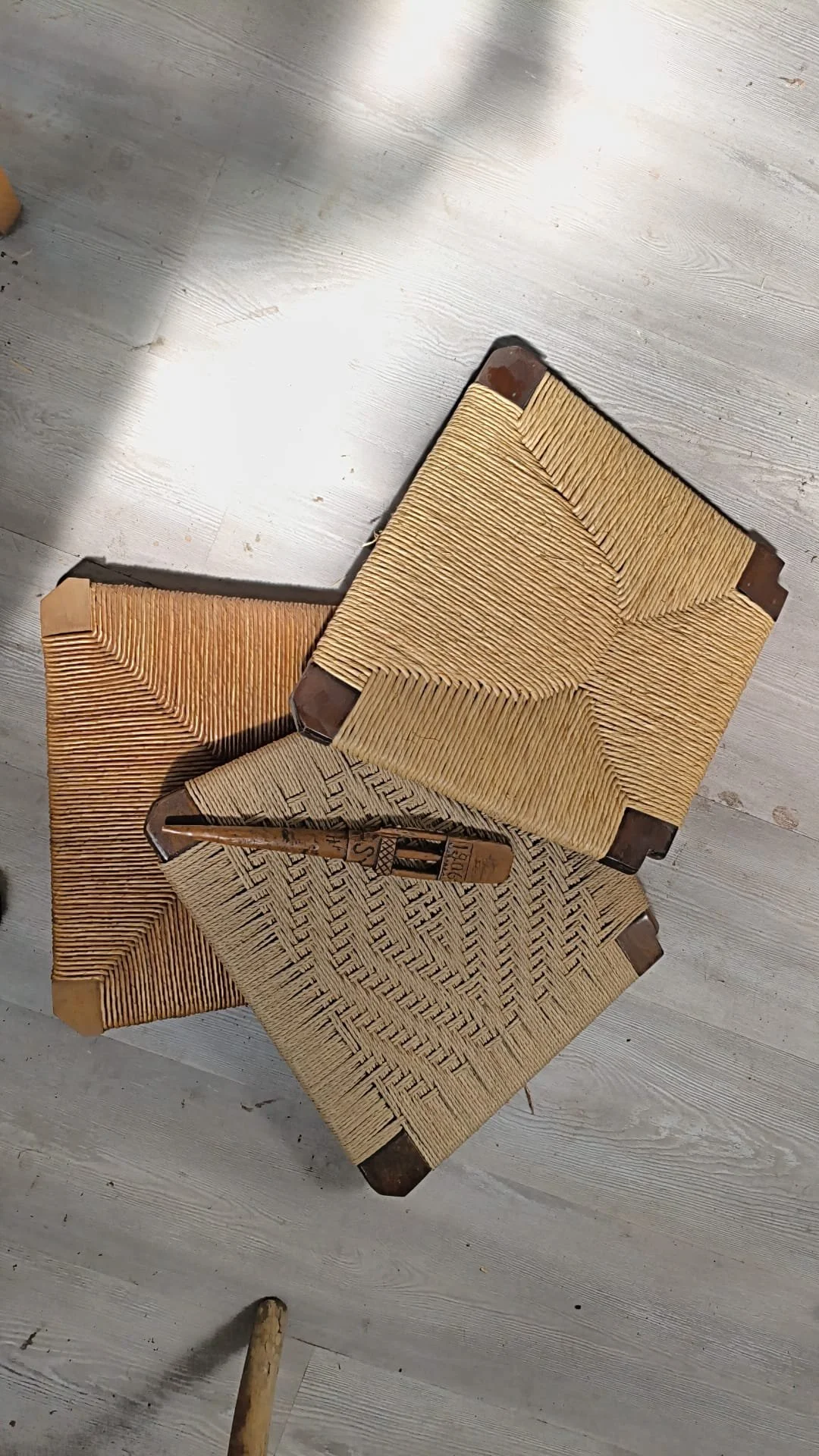
El Fusèt — A small wooden spindle. The master's tool — and his authority.
The author of this document possesses a Fusèt dated 1905, gifted to him by his master, Tita Bosol of Gosaldo. It remains in use today.
The Proverbs of Gosaldo
"I nos veci i se a magnà la roba e i ne a lasà i proverbi."
Our elders consumed their worldly goods and left us their proverbs.
I. Seasons & Weather
Sant'Antoni da la barba bianca — If there is no snow, there will be frost.
(January 17)
Fret de genaro impienìs el granaro. — The cold of January fills the granary.
Marth sut, apríl bagnà — Dry March, wet April: blessed is the farmer who has already sown.
Ros de matina, la piova se avisina. Ros de sera, bon temp se spera. — Red sky at morning, rain is near. Red sky at night, fair weather in sight.
El dì de Santa Lucia l'é el dì pi curt che sia. — Saint Lucy's day is the shortest day of the year.
Montanìn, montanìn: scarpe grose e thervèl fin. — Mountain man, mountain man: heavy shoes and a sharp mind.
II. Work, Money & Thrift
Impara l'arte e metele da parte — Learn your craft and set it aside: the time will come when it will serve you.
I brath l'é la richetha del porét. — The arms are the wealth of the poor.
A laoràr se fala e falando s'impara. — Working, one makes mistakes; making mistakes, one learns.
Porét no l'é chi che no a nia, ma chi che no l'é boni de sparagnàr nia. — Poor is not the one who has nothing, but the one who cannot save anything.
El bonorìf no l va mai imprést dal tardìf. — The early sower never borrows from the late sower.
III. Popular Wisdom
A sto mondo tut vién e tut pasa. — In this world, everything comes and everything passes.
Chi va pian, va san e va lontàn; chi va forte, va a la morte. — Who goes slowly goes safely and far; who goes fast goes to his death.
Tuti i grop i vién al peten. — All knots come to the comb. Everything comes to light in the end.
O magna sta menestra, o salta sta finestra. — Either eat this soup, or jump out the window. Take it or leave it.
Mai lasàr la strada vecia par quela nova. — Never leave the old road for the new one.
Chi therca, cata. — Who seeks, finds.
Rit ben chi che rit par ultim. — He laughs best who laughs last.
IV. Virtues & The Ages of Man
Maestri no se nas, ma se deventa. — Masters are not born — they are made.
La superbia la va a cavàl e la torna a pie. — Pride rides in, and walks home.
Chi sa che no sa, sa de pi de chi che sa. — Who knows he does not know, knows more than who pretends to know.
Ghe n matha pi la lengua che la spada. — The tongue kills more than the sword.
Se l'invidia avese la fiora, tuti l'avarèe. — If envy were a fever, everyone would have it.
A sèt an i é ptèi, a setanta i é ancora quéi. — At seven they are children; at seventy they still are.
V. Love, Marriage & Family
En pare el é bon par set fioi, ma set fioi no i é boni par en pare. — A father can support seven children, but seven children cannot support one father.
Maridàr e semenàr l'é tut en laoràr. — Getting married and sowing seed are both hard work.
Tra suocera e nora l'é doi diaoi che laora. — Between mother-in-law and daughter-in-law, two devils are at work.
Amor de fradei, amor de cortei. — Brothers' love is like knives.
VI. Religion & Providence
No cai na foia che Dio no l voia. — Not a leaf falls without God's will.
Se sera na porta e se verth en porton. — When one door closes, a gate opens.
El Signor el manda el frét secondo i pani. — The Lord sends cold according to the clothes one has.
Mal no far, paura no avér. — Do no evil, have no fear.
VII. Miscellaneous
Salute e libertà l'é n tesoro che no se sa. — Health and freedom are a treasure beyond imagination.
La néf l'é la lana dei prà. — Snow is the wool of the meadows.
El fasol l'é la carne del porét. — Beans are the meat of the poor.
Polenta e osèi l'é magnàr dei dei. — Polenta and birds is food fit for the gods.
Thena longa, vita curta; thena curta, vita longa. — A long supper, a short life; a short supper, a long life.
The complete Heritage Document — including all proverbs, craftsmen testimonies, and cultural notes — is available as a free PDF download.
Benvegnù Heritage is committed to the preservation of this tradition — not as a relic, but as a living practice.
Every chair woven today carries the memory of Gosaldo, the campaigns across Italy and France, and the hands of those who came before.
"Maestri no se nas, ma se deventa."
Masters are not born — they are made.