
Our Story
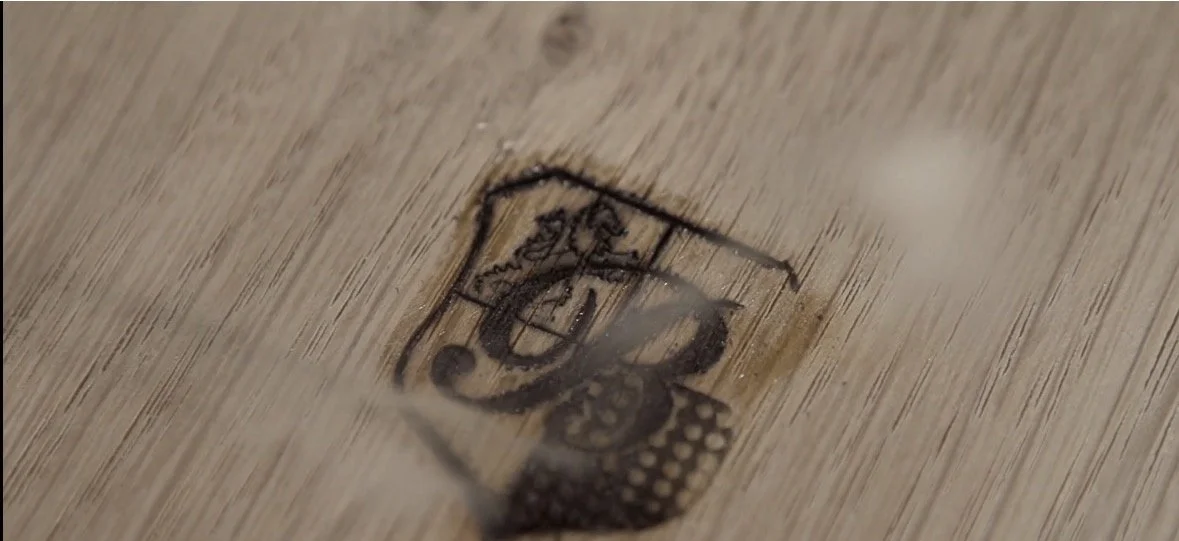
Benvegnù—where tradition becomes art
Raised among chairs
I was raised by my grandparents, between the valleys of the Agordino and Milan. At six months old I was already in the mountains, with my grandparents and my great-grandmother. I learned the dialect and the scopelament — the chair weavers’ secret tongue — perhaps before I learned Italian.
Playing among my grandparents’ chairs and tools was simply ordinary life. The caora, the coltel da ponta, the gouge were the most coveted toys. I grew up among marsh rush and old conza.
The Benvegnù grandparents
Grandfather Erminio was from Taibon Agordino; grandmother Gigia from Rivamonte Agordino — the finest couple in the valley. The Benvegnù are my mother’s family. Pallone, my surname, comes from my father, of Calabrian origin — though I don’t speak a word of Calabrian. My language is the one of the Dolomites.
Grandfather no longer worked the marsh rush, but he was a master of Vienna cane and of corded weaving. In the 1950s, in Milan, they repaired chairs — carrying them stacked in tall towers, one above the other, by bicycle, across the city, stage by stage, all the way home. There they drilled, cleaned, and re-wove the caning and the corded medallions, with all their patterns.
The craft runs in the family. My grandfather’s brother, uncle Angelo, kept a workshop on Via del Gesù, steps from Montenapoleone. The whole family was known and respected in the trade. As a boy, it was ordinary for me to go with my grandmother to Sampierdarena to buy materials, or to restorers, antique dealers and private clients to collect and deliver work.
I grew up among the skeins of Vienna cane, and learned early: first the cross-strands, then the weave.
My grandfather’s refusal, and Tita Bosol
There was one thing my grandfather would never teach me: to weave with stupina, with marsh rush. He flatly refused. He even made gerle — but when I asked him, all he said was: “never again will I weave a chair in rush.” I never learned why.
So my grandmother Gigia asked Tita Bosol, by then eighty years old, whether he would teach me. I lived with her until I was six, and long after; it was she, more than anyone, who kept me within the craft. Tita was overjoyed — that someone still wanted to learn.
“Learn the craft, and set it aside.”
One summer, in the late 1990s, I spent my holidays as his apprentice. He taught me to prepare the material and the weaving techniques: from the baggi to the two cords, the shape of the seat, the back — where the spine must slide against the rest. We made four cherry-wood chairs, starting from a tree trunk. Four masterpieces I still own, in Milan, at my mother’s, and will never sell. They have turned red by now: cherry is so warm, so willing under the hand. He had two long, curled moustaches. He spoke Italian with difficulty — but with me he had no need to. Years later I showed him some of my work. He gave me his most sincere compliment:
“La man te la vet subito — e ti te la ha.” / You can see the hand at once — and you have it.
He gave me his Fusèt, dated 1905, as though it were a diploma. It remains in use to this day.
A family of chair weavers
Mine is not the story of one man, but of a family. For generations, the Benvegnù were chair weavers. Grandfather Erminio and grandmother Gigia; uncle Angelo, with his workshop on Via del Gesù; uncle Purin and aunt Pia; and uncle Ilario, my grandmother’s brother, a conza who travelled the world as far as Australia — and after whom I named my son. My mother wove too; and my father, a Calabrian, learned the craft. Today the hand continues: in my brother, and in my nephew.
Milan, and the ocean
When my grandparents grew too old, keeping the workshop alive in Italy proved unsustainable. So I did what the Conthe had always done: I packed up the craft and carried it where it could live — this time, across an ocean, to Hamilton.
The tradition, then, I did not leave behind in Italy. I carried it with me. That is what Benvegnù Heritage is today: the hand of the Conthe, alive, from the Dolomites to Hamilton.
Closing
A stitch by stitch, a coat is made. So too are the stories woven into every chair at Benvegnù Heritage. When you sit in one of our chairs, you feel the weight of a hundred years of tradition. Welcome to the future, crafted with the hands of the past.